



WORK CONTENT IN THE NIGERIAN CIVIL SERVICE AND ITS IMPLICATION ON SUSTAINABLE DEVELOPMENT
- Authors
-
-
Igbokwe-Ibeto Chinyeaka Justine Agbodike
Department of Public Administration, Faculty of Management Sciences Nnamdi Azikiwe University, P.M.B 5025, Awka, Anambra State-Nigeria -
Florence & Osawe
2Department of Public Administration, Faculty of Management Sciences Nnamdi Azikiwe University, P.M.B 5025, Awka, Anambra State-Nigeria -
Cyril
Department of Public Administration, Faculty of Management Sciences, Lagos State University, Ojo
-
- Keywords:
- Design, Responsibility, Task, National Development, Job
- Abstract
-
Civil service is the major instrument through which government; federal, state or local manage development. However, Nigerian civil service has for long been engulfed with poor performance and service delivery. Reforms in the civil service have often centered on structure and deemphasized work content. Specifically, attention is paid to the powers of officials, inter-unit conflict, and delegation of authority, training and accountability. Regardless of emphasis on these factors, work in the civil service remains dull, slow, and monotonous, and a high degree of employee idleness is nothing to write home about. Within the framework of labour productivity theory and using primary data collected from highly-skilled professionals in three states of South-East Nigeria. The paper concludes that the conspicuous lack of activity among many civil service employees’ is primarily a function of low work content in service occasioned by overstaffing. To achieve sustainable development in Nigeria, job enrichment and decongestion of the civil service by alternative employment (DAE) is therefore recommended
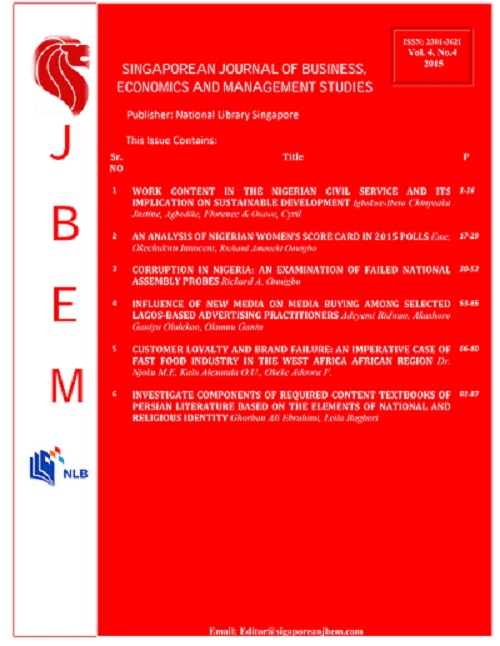
- Cover Image
-
- Downloads
- Published
- 2015-04-30
- Issue
- Vol. 4 No. 4 (2015)
- Section
- Articles
Similar Articles
- Ogunkoya Olufemi A, Shodiya Olayinka A., Babatunde Oyinade, Ph.D, Ifedayo Daramola, Ph.D, MANAGEMENT DESIGN AND DIFFERENTIAL AGENCY: CHALLENGES ARISING IN TOURISM ACCOMMODATION PROPERTIES IN NIGERIA , Singaporean Journal of Business Economics and Management: Vol. 2 No. (4)
- BELLO, Adesina Temitayo (PhD), RESOLVING AND MANAGING CONFLICTS WITHOUT AGGRESSION IN INTERNATIONAL POLITICS , Singaporean Journal of Business Economics and Management: Vol. 3 No. (2)
- Reza Nazari, Masoud Gholami, Jafar Vaghari Ghorbai, VIRTUAL ORGANIZATIONS: INFORMATION TECHNOLOGY , Singaporean Journal of Business Economics and Management: Vol. 1 No. (9)
- Okorie G. U, Elenwa C.O., UTILIZATION OF CLIMATE CHANGE INFORMATION BY GENDER FOR CLIMATE ADAPTATION AMONG ARABLE CROP FARMERS IN OYIGBO LOCAL GOVERNMENT AREA, RIVERS STATE, NIGERIA , Singaporean Journal of Business Economics and Management: Vol. 8 No. (2) (2021)
- Morteza Chavoshi, Melika Ashouri, ECONOMIC FACTORS AFFECTING THE CONSUMER'S CHOICE OF DENTAL SERVICES , Singaporean Journal of Business Economics and Management: Vol. 8 No. (3) (2021)
- Hamidreza Asgarsani, Omid Duostdar, AminGohar Rostami, EMPOWERMENT AND ITS IMPACT ON THE ORGANIZATION PRODUCTIVITY , Singaporean Journal of Business Economics and Management: Vol. 1 No. (9)
- Bizhan Shafie, Saeid Baghersalimi, Vahid Barghi, THE RELATIONSHIP BETWEEN LEADERSHIP STYLE AND EMPLOYEE PERFORMANCE , Singaporean Journal of Business Economics and Management: Vol. 2 No. (5)
- Ofobruku Sylvester Abomeh, Nwakoby Nkiru Peace, EFFECTS OF MENTORING ON EMPLOYEES’ PERFORMANCE IN SELECTED FAMILY BUSINESS IN ABUJA, NIGERIA , Singaporean Journal of Business Economics and Management: Vol. 4 No. (9) (2015)
- Prashant Saxena, Ms. Shilpa Bendale, ‘Managerial Competencies’ in Indian Business Context – An Empirical Analysis , Singaporean Journal of Business Economics and Management: Vol. 2 No. (1)
- BehzadTaktaz, SedighehShabaani, Atefeh Kheyri, Mahdieh Rahemipoor, The Relation between Psychological Empowerment and Performance of Employees , Singaporean Journal of Business Economics and Management: Vol. 1 No. (5)
You may also start an advanced similarity search for this article.